Friday, November 25, 2011

VOCABULARY: novas palavras aprendidas em Inglês

Então pessoal, há palavras que às vezes a gente não sabe nem em Português, quem dera em outro idioma.

Estou estudando Física e Matemática em Inglês, e além de aprender as matérias em si, o ganho de vocabulário começa a ser significativo também. Eu acho isso super bacana, pois adoro o idioma e quanto mais eu conhecê-lo, mas mais eu sinto satisfeito.

Pois então, seguem as novas palavras aprendidas:

  • sawhorse = cavalete
  • hinge => dobradiça (de porta)
  • turnstile => catraca (as rotatórias como as de estação de trem)
  • velocity => vetor velocidade (módulo e direção)
  • speed => módulo do vetor velocidade (apenas o módulo)
  • right triangle => triângulo retângulo
  • legs => catetos do triângulo retângulo (hipotenusa é hypotenuse)
  • AC/DC => DC, o que chamamos de corrente contínua é direct current no Inglês, por isso DC e não CC
  • numerical analysis => cálculo numérico
  • momentum => momento ou quantidade de movimento (q = m x v)
  • moment => momento de inércia
Uma nota importante é que, do meu aprendizado de Inglês, longe da Física, sempre soube que velocity e speed eram a mesma coisa, com a única diferença sendo a primeira usada em contextos mais formais, ao passo que speed era um termo mais corriqueiro, casual. Contudo, na Física, são coisas diferentes, velocity é um vetor, speed é apenas a magnitude/módulo desse vetor.

Outra coisa interessante é a tradução para o mesmo termo "momento" em Português, duas grandezas que são diferentes e que têm termos distintos em Inglês, momentum e moment. Momentum é um presente direto do Latin cujo plural é momenta, e na língua Inglesa tal palavra se manteve para descrever a quantidade de movimento dos objetos. Em Português, ao contrário, o estudante precisa tomar cuidado ou estar bem atento ao contexto para não cometer o erro de calcular uma coisa quando a outra é pedida, pois são grandezas de mesmo nome.

Conforme novas palavras forem surgindo, trarei mais vocabulário para todos.

Abraços!

Wednesday, November 23, 2011

O descompromisso do ser humano na internet


Acredito que eu não vá conseguir dormir sem esse desabafo aqui, então vamos adiante.

Também gostaria de mencionar que esse texto aqui não é uma indireta para alguém em particular, pois refere-se a um comportamento comum entre várias pessoas.

Antes de mais nada, gostaria de dizer o que me motivou a vir aqui escrever isso, uma mistura de um desabafo com uma análise crítica do porquê acredito que aconteça tal coisa. O fato intrigante é: ser ignorado pelas pessoas quando você as procura online, em comunidades como Facebook ou Orkut. Após vários meses em tentativas frustradas de comunicação com as pessoas, fui levado a me expressar através desta postagem.

Eu acho incrível a quantidade de pessoas, e na vasta maioria dos casos, brasileiros, que simplesmente deixam você na mão quando você se dirige a elas online, nem que seja para responder um simples “Olá, como vai?” A queixa não é porque isso acontece uma vez e eu fico intrigado, mas sim porque isso acontece diversas vezes, para uma mesma pessoa, às vezes fica-se dias ou semanas, e mesmo procurando as pessoas mais de uma vez neste período, elas não te respondem, e porque não querem. Isso fica evidenciado quando você vê, durante todos os dias em que aguarda uma resposta, as pessoas em questão ficam postando, muitas vezes, pura abobrinha para todos os lados nos murais de outras pessoas, ou seja, você sabe que elas estão online, ativas, dia após dia, então nem é possível engolir delas que não responderam por falta de tempo.

No meu ponto de vista, é mera questão de educação, se alguém dirige a palavra a você, você de alguma forma retornar a ela, mesmo que seja na manifestação de que não sente afinidade com tal pessoa e a preferiria deixá-la de lado, algo que não é possível adivinhar quando a única resposta que se recebe é o silêncio.

Há um princípio básico, dá até pra chamar de lei da natureza: aonde há uma pergunta, uma resposta é esperada. O quão impossível será entender isso? As pessoas se escondem, fingem não ver, ignoram, tratam a atenção que as pessoas as dirigem como algo sem importância, como se fosse um bocejo, aquela coisa que acontece, nós vemos, e ignoramos, por não ser absolutamente nada de importante.

O que às vezes chega a ser revoltante nestas situações é que quando você insiste em ir atrás das pessoas, elas se irritam, acham que você está sendo chato, enchendo o saco ou coisa do tipo. Expressam suas idéias como se elas estivessem corretas e você fosse um impertinente. Agora, quem está certo em uma situação como essa? Você vai atrás da pessoa, você demonstra se importar com ela (senão não iria atrás p@#$%), às vezes compartilha com ela assuntos do interesse delas, e é constantemente ignorado, às vezes por pessoas de relacionamento saudável quando diretamente, e no final, após tamanha demonstração de interesse pela pessoa você é transformado em vilão, é recebido com pedras na mão, será que isso é justo? Não seria mais fácil, se eu não significo nada no perfil de tal pessoa, porque não me remove e pára com tal palhaçada?

Hoje eu abordei superficialmente o assunto com uma pessoa muito querida, ela me disse que é normal se decepcionar com as pessoas quando você tem expectativas para com elas. Bom, ela não me disse novidade alguma, embora eu não tenha dito a ela que saber disso pra mim não justifica a falta de educação mínima das pessoas online.

Eu cheguei a comentar com ela uma vez, um teste que fiz no Orkut, eu passava no perfil de uma pessoa, inclusive uma com a qual tinha um bom relacionamento diretamente, e passava lá para cumprimentá-la e saber como ela estava (acho que tinha alguma coisa a mais no scrap). Eu lhe disse que a cada mensagem que mandava, ao lado, eu mandava um contador, algo parecido com “Olá, tudo bem?” [1]. Na segunda vez, obviamente o número seria [2], e assim por diante. Eu fazia isso ao longo de umas 2 semanas, obviamente não todos os dias para dar tempo das pessoas responderem, muitas vezes vendo que a pessoa estava online, participando em outros lugares, e não respondendo por falta de interesse mesmo. Quando chegava no [4], eu mandava um texto adicional, informando que aquela seria a última vez que a procuraria, e se tivesse uma quinta vez, iria aparecer apenas para informar que estaria removendo tal pessoa do perfil por um motivo muito simples: ser ignorado de forma constante!

Confesso que isso aconteceu foram 2 vezes, cheguei na quarta vez com 2 pessoas, e após o aviso (alguns vêem como ameaça) de que na próxima vez seriam excluídos do meu perfil, vinham chorosos dizendo “desculpa, andei muito ocupado...” e eu pensava comigo mesmo “vai mentir lá na caixa prego, pois tempo pra baboseira você tem”.

Ainda referente a esta querida amiga, quando lhe contei sobre os contadores, ela disse pra mim que isso era terrorismo da minha parte. Terrorismo? Ser ignorado pelas pessoas de forma constante e dizer isso a elas, informando o que é justo, remoção de perfil, pode ser encarado como terrorismo? As pessoas são um mar de descaso com você e ir atrás delas revelar isso deve ser tratado como terrorismo? O contador serve apenas para revelar o quão displicentes tais pessoas são. Ela chegou a dizer “se eu não quero responder uma pessoa, eu não respondo”, e muitos fazem isso, dando a idéia de que não há obrigação de fazer isso. Bom, obrigação é claro que não existe, mas será que não há algo errado nisso aí, deixar uma pessoa falando sozinha com constância? Qual seria o nome disso se fosse fora do Facebook? Eu vejo que responder as pessoas que nos procuram como mera questão de educação, salvo quando realmente não se tem tempo pra isso, será que alguém discorda disso?

Eu expliquei a ela que, comigo, quando tal coisa acontece, ser ignorado com frequência, eu sou automaticamente levado a pensar que há alguma coisa errada entre eu e a pessoa, ela deve estar com o pé atrás comigo por alguma razão, e o pior é que não fala comigo pra eu conferir se sim ou não.

Confesso que perdi a conta de quantas foram as coisas que enviei/compartilhei com ela e passei longe de ter o retorno esperado, muitas vezes sem retorno algum. Contudo, disse a ela que ela é a única pessoa que eu tolero isso no momento, por gostar muito dela, por saber que ela é bem ocupada, teve alguns problemas de internet em sua casa nas últimas semanas, tenho contato em pessoa com ela e sei que as coisas andam bem entre nós, e por último, por não enxergar ela como uma usuária assídua de internet, que faz usos dos recursos, por exemplo, que o Facebook oferece como são esperados, a citar o uso de mensagens privadas, pois aquilo não é canal de comunicação de uma via só. Acredito que talvez, talvez eu disse, ela entre no grupo em que eu classifico como o dos descompromissados da internet.

Eu gostaria muito que essas pessoas entendessem que elas não estão conversando com a internet, mas sim com pessoas. Gostaria que elas lembrassem que pessoas têm expectativas, quando elas falam, elas esperam alguma coisa de retorno, na vasta maioria dos casos. Quando há uma pergunta então, é mais do que óbvio que uma resposta é esperada. Seria bom que elas soubessem que há quem se fruste com tamanha falta de educação, ser ignorado com constância, coisa básica do ser humano. A exemplo do meu caso, como citei, se estes eventos acontecem com constância, e eu vejo que não é por falta de tempo pois há tempo suficiente para assuntos sem nexo em murais pra todo lado, eu sou automaticamente levado a pensar que há algo errado entre eu e a pessoa, isso me incomoda, e é do meu perfil ir atrás pra saber o que acontece para que seja resolvido, sem jamais permanecer na palhaçada de negligência constante.

O que eu enxergo como causa deste problema é o fato das pessoas, muitas delas, quando em uma comunidade de relacionamento por exemplo, serem totalmente descompromissadas para com qualquer assunto que seja sério ou formal, utilizando o ambiente como um refúgio longe de compromissos, podendo desfrutar de um lugar geralmente difícil de encontrar na vida real, uma “casa da mãe joana”. Estas pessoas não enxergam o Facebook como um site de relacionamentos, mas sim como um parquinho de diversões onde participam apenas dos brinquedos e das brincadeiras que lhes interessam, não estão lá pra se relacionar, se comunicar, mas pra se divertir com o que lhes interessam dependendo do tipo de dia que estão tendo.

As pessoas sentem-se à vontade pra dizer coisas do tipo “vou no banheiro”, “amor, eu te amo, volta logo”, “aí, eu estou tão triste hoje”, “acho que vou comprar um carro”, etc. etc. etc. juntamente de um monte de coisa inútil, expressões momentâneas de pessoas que não estão fazendo nada de importante e jogam isso no ar para ver com o que as outras pessoas complementam. Piadas para todos os lados, uma curtição enorme de fotos, frases prontas que são copiadas de um lado pro outro, sobre religião, amor, ser feliz, futebol, etc. etc.

Diante de um ambiente como esses, creio eu, a vasta maioria das pessoas sentem-se em um ambiente longe de formalismos e coisas sérias, havendo pouca apreciação quando tais manifestações ocorrem, e se passa a ocorrer com mais constância, você é visto como uma carta fora do baralho, uma pessoa chata, e outras coisas mais, só porque não entra no mesmo bonde da inutilidade da maioria.

O que eu canso de ver, no meu caso, é simples frases como “Olá, tudo bem?” sendo tratadas como porcaria nenhuma diante de diversas baboseiras sem sentido para as quais as pessoas encontram tempo. Este exemplo do “Olá, tudo bem?” é só um exemplo simplório, às vezes há muito mais conteúdo que isso. O que passa na cabeça de tal pessoa quando vê uma mensagem nova, lê, e larga pra lá? Será que é demais a minha atitude, sempre verificar quem se comunicou comigo e cuidar pra não deixar ninguém na mão, retornando a elas assim que possível? Será que eu estou fazendo demais? Eu sou o chato? Será que ter atenção para com você (você mesmo) é crime? Ah, é mesmo, o nome disso é compromisso, responsabilidade para com as pessoas, mas o Facebook e a internet não é lugar pra isso não é mesmo? Você que afirma que sim o faz apenas porque você não é vítima disso... Eu jamais me esqueço que estou me relacionando com pessoas, reais, elas são como eu, e merecem atenção devida.

A internet e tais comunidades tornaram-se um excelente meio de comunicação para aquelas pessoas com as quais a vida tratou de separar, um meio de manter amizades ativas quando a distância prevalece. Aí fica no ar, se não há comunicação com tais pessoas nem pela internet, com ambas adicionadas no perfil de cada uma, como manter um relacionamento? O Facebook seria uma comunidade de relacionamento ou um parque de baboseiras? Eu enxergo que sim, é para as pessoas não se perderem de vista, incitar a comunicação, manter amizades e etc. pois afinal, estamos lidando com gente, o que é que muda com relação a vida fora da internet? Eu continuo sendo o mesmo dentro e fora do Facebook, falo na comunidade online de coisas reais, então porque receber tratamento diferenciado quando em um local e quando no outro, e pior, oriundos da mesma pessoa? Tem nexo isso?

No meu ponto de vista, a grande noção de descompromisso na internet faz com que as pessoas lá compromissadas passem por situações como a minha, e não, não vejo ser demais da minha parte cuidar para que a sua mensagem, a de seu amigo, e de outras pessoas, não sejam jogadas no lixo, especialmente se você importa pra mim. Se eu te procuro, bato nesta tecla contigo, tenha a certeza que é porque me importo contigo, senão teria largado mão de ti de uma vez. É muito ruim tentar fazer tudo isso por você e ser tratado como vilão da história, um cara chato, por fazer o quê? Por te procurar e mostrar que você tem valor...

O interessante é que não passo por tal problema com constância com os meus contatos do exterior. Eu mantenho amizades há anos por email e tais comunidades, lugares como China, Tailândia, Polônia, etc. e não costumo ver esta falta de compromisso com as pessoas... será que é coisa de brasileiro mesmo?

Alguém poderia pensar “meu, você esquenta demais com essas coisas...”, aí eu falo “tá vendo como você não tem compromisso com as pessoas ou não vê isso como importante?”; outro “eu não vou ficar esquentando minha cabeça com Facebook que nem ele”, e eu retorno “eu não estou esquentando com o Facebook, eu estou é dando atenção pra você que não enxerga isso”; "você leva Facebook muito a sério!", e eu digo "errado, pois o que eu levo a sério são as pessoas, ou será que você não merece"?

Eu jamais vou pensar que dar a atenção que você merece seja um erro da minha parte, pois o erro talvez seja esperar a mesma atitude de um monte de pessoas que não compartilham da mesma linha de pensamento que a minha. Contudo, lembre-se, um dia pode ser você a vítima, de repente é até alguém que você gosta que venha a te tratar com o silêncio, alguém com a qual você gostaria muito de conversar, a internet seria o meio mais viável, porém... quem sabe a partir daí você não comece a pensar mais nos outros.

Por último, uma preocupação minha, exatamente com a estimada amiga que citei acima. Nossa comunicação verbal vai muito bem, embora ela não ocorra tantas vezes como eu gostaria. A partir do ano que vem, acontecerão algumas mudanças em sua vida que tendem a afastá-la de mim, diminuindo e muito a comunicação verbal que é muito boa. Aí eu pergunto, se a comunicação via internet é extremamente ruim, não há retorno de praticamente nada que se comunica, como manter contato, ter as agradáveis e produtivas conversas, manter a chama da amizade acessa nos momentos onde a distância impera? Sinceramente, se fosse hoje, pela lógica, estaria tudo no limbo, não teria mais contato com ela nem em pessoa (salvo alguma ocasião excepcional) e nem pela internet, sendo o telefone um recurso um pouco limitado também. Aí eu pergunto? É demais da minha parte se preocupar com isso? Se fosse com você, seria demais dirigir esse nível de atenção à pessoa estimada? Eu curto demais ela, é uma pessoa um pouco diferenciada da maioria que conheço, consigo ter conversas que geralmente são difíceis de abordar com a maioria das pessoas, eu me importo com ela e não gostaria de perder isso. Claro, estou apenas fazendo a minha parte, isso é o típico do exemplo onde os dois têm que “mover seus pauzinhos” para não se perder o que se conquistou de valor, estou tentando garantir a minha parte, e isso inclui sim a utilização da internet, e por que não, o Facebook? Acho uma pena que hoje a utilização da internet por ela seja tão ineficaz, neste sentido, para mantermos contato, e de repente conversar até as coisas que não dá tempo de abordar em pessoa. Apesar de tudo, eu entendo, ela provavelmente não vê e não enxerga o uso de internet como meio de comunicação da mesma forma que eu, assim como muitas pessoas, então isso faz com que eu prossiga me questionando sobre como será o amanhã entre nós...

Não sei quantos se identificam com a minha situação, passam por algo similar, etc. Isso acontece comigo com várias pessoas, inclusive com aquelas com as quais meu relacionamento é muito bem em pessoa. Felizmente, ainda há um bom número que se comunica devidamente comigo (mostrando um mínimo de educação para com a atenção que lhes é dirigida). Seria interessante ver outras opiniões sobre o descaso das pessoas na internet, pois duvido que isso ocorra apenas comigo. A postura que as pessoas assumem online pode ser um assunto pra muita discussão, para quem estiver disposto, independente do meu caso em particular, há um total descaso, muito desdém, só porque não se está diante das pessoas, cara-a-cara.

Vejo que a web veio forte para a nossa vida, e veio pra ficar. Será que fazemos o correto uso delas para nos comunicarmos com as pessoas que importam pra nós, seja no lado pessoal ou profissional?

A vida segue, vou tentar não esquentar tanto com isso (sempre esquento quando as pessoas envolvidas importam pra mim), e vamos adiante.

Abraços!

Sunday, October 23, 2011

Numerical Analysis (Newton's Method)


Introduction

Newton's method is a technique for finding the root of a scalar-valued function f(x) of a single variable x. It has rapid convergence properties but requires that model information providing the derivative exists.

Background

Useful background for this topic includes:

References

Theory

Assumptions

Newton's method is based on the assumption that functions with continuous derivatives look like straight lines when you zoom in closely enough to the functions. This is demonstrated here.
We will assume that f(x) is a scalar-valued function of a single variable x and that f(x) has a continuous derivative f(1)(x) which we can compute.

Derivation

Suppose we have an approximation xa to a root r of f(x), that is, f(r) = 0. Figure 1 shows a function with a root and an approximation to that root.
Figure 1. A function f(x), a root r, and an approximation to that root xa.

Because f(x) has a continuous derivative, it follows that at any point on the curve of f(x), if we examine it closely enough, that it will look like a straight line. If this is the case, why not approximate the function at (xa, f(xa)) by a straight line which is tangent Txa to the curve at that point? This is shown in Figure 2.

Figure 2. The line tangent to the point (xa, f(xa)).

The formula for this line may be deduced quite easily: the linear polynomial f(1)(xa) ⋅ (x - xa) is zero at xa and has a slope of f(1)(xa), and therefore, if we add f(xa), it will be tangent to the given point on the curve, that is, the linear polynomial


is the tangent line. Because the tangent line is a good approximation to the function, it follows that the root of the tangent line should be a better approximation to the root than xa, and solving for the root of the tangent is straight-forward:

HOWTO

Problem

Given a function of one variable, f(x), find a value r (called a root) such that f(r) = 0.

Assumptions

We will assume that the function f(x) is continuous and has a continuous derivative.

Tools

We will use sampling, the derivative, and iteration. Information about the derivative is derived from the model. We use Taylor series for error analysis.

Initial Requirements

We have an initial approximation x0 of the root.

Iteration Process

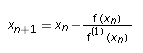
Given the approximation xn, the next approximation xn + 1 is defined to be

Halting Conditions

There are three conditions which may cause the iteration process to halt:
  1. We halt if both of the following conditions are met:
    • The step between successive iterates is sufficiently small, |xn + 1 - xn| < εstep, and
    • The function evaluated at the point xn + 1 is sufficiently small, |f(xn + 1)| < εabs.
  2. If the derivative f(1)(xn) = 0, the iteration process fails (division-by-zero) and we halt.
  3. If we have iterated some maximum number of times, say N, and have not met Condition 1, we halt and indicate that a solution was not found.
If we halt due to Condition 1, we state that xn + 1 is our approximation to the root.
If we halt due to either Condition 2 or 3, we may either choose a different initial approximation x0, or state that a solution may not exist.

Error Analysis

Given that we are using Newton's method to approximate a root of the function f(x).
Suppose we have an approximation of the root xn which has an error of (r - xn). What is the error of the next approximationxn + 1 found after one iteration of Newton's method?
Suppose r is the actual root of f(x). Then from the Taylor series, we have that:

where ξ ∈ [r, xn]. Note, however, that f(r) = 0, so if we set the left-hand side to zero and divide both sides by f(1)(xn), we get:


We can bring the first two terms to the left-hand side and multiple each side by -1. For the next step, I will group two of the terms on the terms on the left-hand side:


Note that the object in the parentheses on the left-hand side is, by definition, xn + 1 (after all, xn + 1 = xn - f(xn)/f(1)(xn) ), and thus we have:


But the left hand side is the error of xn + 1, and therefore we see that error is reduced by a scalar multiple of the square of the previous error.
To demonstrate this, let us find the root of f(x) = ex - 2 starting with x0 = 1. We note that the 1st and 2nd derivatives of f(x) are equal, so we will approximate ½ f(2)(ξ)/f(1)(xn) by ½. Table 1 shows the Newton iterates, their absolute errors, and the approximation of the error based on the square previous error.
Table 1. Newton iterates in finding a root of f(x) = ex - 2.
nxnerrn = ln(2) - xn½ errn - 12
01.0-3.069 ⋅ 10-1N/A
10.735758882342885-4.261 ⋅ 10-2-4.708 ⋅ 10-2
20.694042299918915-8.951 ⋅ 10-4-9.079 ⋅ 10-4
30.693147581059771-4.005 ⋅ 10-7-4.006 ⋅ 10-7
40.693147180560025-8.016 ⋅ 10-14-8.020 ⋅ 10-14
Note that the error at the nth step is very closely approximated by the error of the (n - 1)th step. Now, in reality, we do not know what the actual error is (otherwise, we wouldn't be using Newton's method, would we?) but this reassures us that, under reasonable conditions, Newton's method will converge very quickly.

Failure of Newton's Method

The above formula suggests that there are three situations where Newton's method may not converge quickly:
  1. Our approximation is far away from the actual root,
  2. The 2nd derivative is very large, or
  3. The derivative at xn is close to zero.

Examples

Example 1

As an example of Newton's method, suppose we wish to find a root of the function f(x) = cos(x) + 2 sin(x) + x2. A closed form solution for x does not exist so we must use a numerical technique. We will use x0 = 0 as our initial approximation. We will let the two values εstep = 0.001 and εabs = 0.001 and we will halt after a maximum of N = 100 iterations.
From calculus, we know that the derivative of the given function is f(1)(x) = -sin(x) + 2 cos(x) + 2x.
We will use four decimal digit arithmetic to find a solution and the resulting iteration is shown in Table 1.
Table 1. Newton's method applied to f(x) = cos(x) + 2 sin(x) + x2.
nxnxn + 1|f(xn + 1)||xn + 1 - xn|
00.0-0.50000.16880.5000
1-0.5000-0.63680.02050.1368
2-0.6368-0.65890.00080000.02210
3-0.6589-0.65980.00060.0009
Thus, with the last step, both halting conditions are met, and therefore, after four iterations, our approximation to the root is -0.6598 .

Questions

Question 1

Find a root of the function f(x) = e-x cos(x) starting with x0 = 1.3 . The terminating conditions are given by εabs = 1e-5 and εstep = 1e-5.
Answer: 1.57079632679490 after five iterations.

Question 2

Perform three steps of Newton's method for the function f(x) = x2 - 2 starting with x0 = 1. Use a calculator for the third step.
Answer: 3/2, 17/12, 577/408 ≈ 1.414215686274510

Applications to Engineering

Consider the circuit, consisting of a voltage source, a resistor, and a diode, shown in Figure 1.


Suppose we wish to find the current running through this circuit. To do so, we can use Kirchhoff's voltage law (KVL) which says that the sum of the voltages around a loop is zero. For this, we need the model of diode which states that the relationship between the current and the voltage across a diode is given by the equation


Solving this equation for the voltage v and using values IS = 8.3e-10 A, VT = 0.7 V, and n = 2, we get from KVL that

This equation cannot be solved exactly for the current with any of the tools available in an undergraduate program (it requires the use of the Lambert W function). Therefore we must resort to using numerical methods:
Defining the left hand side of the equation to be v(i), we have to solve v(i) = 0 for i, and we will continue iterating until εstep< 1e-10 and εabs < 1e-5.Table 1. Newton's method applied to v(i).
ninin + 1|v(in + 1)||in + 1 - in|
00.02.964283918e-100.07242.96e-10
12.964283918e-103.547336588e-101.81e-35.83e-11
23.547336588-103.562680160-101.17e-51.53e-12
33.562680160e-103.562690102e-102.63e-99.94e-16
Therefore, the current is approximately 3.562690102e-10 A.

Matlab

Finding a root of f(x) = cos(x):
eps_step = 1e-5;
eps_abs = 1e-5;
N = 100;
x = 0.2;

for i=1:N
    xn = x - cos(x)/( -sin(x) );

    if abs( x - xn ) < eps_step && abs( cos( xn ) ) < eps_abs
       break;
    elseif i == N
       error( 'Newton\'s method did not converge' );
    end

    x = xn;
end

xn
        
What happens if you start with smaller values of x? Why?

Maple

The following commands in Maple:
with( Student[Calculus1] ):
NewtonsMethod( cos(x), x = 0.5, output = plot, iterations = 5 );
produces the plot in Figure 1: 

For more help on Newton's method or on the Student[Calculus1] package, enter:

?NewtonsMethod
?Student , Calculus1

Numerical Analysis (The Bisection Method)


Introduction

The bisection method is simple, robust, and straight-forward: take an interval [a, b] such that f(a) and f(b) have opposite signs, find the midpoint of [a, b], and then decide whether the root lies on [a, (a + b)/2] or [(a + b)/2, b]. Repeat until the interval is sufficiently small.

Background

Useful background for this topic includes:

References


Theory


Intermediate Value Theorem (IVT)

Given a continuous real-valued function f(x) defined on an interval [a, b], then if y is a point between the values of f(a) and f(b), then there exists a point r such that y = f(r).
As an example, consider the function f(x) = sin(x) defined on [1, 6]. The function is continuous on this interval, and the point 0.5 lies between the values of sin(1) ≈ 0.841 and sin(6) ≈ -0.279. Thus, there is at least one point r (there may be more) on the interval [1, 6] such that sin(r) = 0.5. In this case, r ≈ 2.61799. This is shown in Figure 1.
Figure 1. The IVT applied to sin(x) on [1, 6] with y = 0.5.


Using the IVT to Bound a Root


Suppose we have a function f(x) and an interval [a, b] such that either the case that f(a) > 0 and f(b) < 0 or the case that f(a) < 0 and f(b) > 0, that is, f(a) and f(b) have opposite signs. Then, the value 0 lies between f(a) and f(b), and therefore, there must exist a point r on [a, b] such that f(r) = 0.
We may refine our approximation to the root by dividing the interval into two: find the midpoint c = (a + b)/2. In any real world problem, it is very unlikely that f(c) = 0, however if we are that lucky, then we have found a root. More likely, if f(a) and f(c) have opposite signs, then a root must lie on the interval [a, c]. The only other possibility is that f(c) and f(b) have opposite signs, and therefore the root must lie on the interval [c, b].
We may repeat this process numerous times, each time halving the size of the interval.

Example

An example of bisecting is shown in Figure 2. With each step, the midpoint is shown in blue and the portion of the function which does not contain the root is shaded in grey. As the iteration continues, the interval on which the root lies gets smaller and smaller. The first two bisection points are 3 and 4.
Figure 2. The bisection method applied to sin(x) starting with the interval [1, 5].


HOWTO


Problem

Given a function of one variable, f(x), find a value r (called a root) such that f(r) = 0.

Assumptions

We will assume that the function f(x) is continuous.

Tools

We will use sampling, bracketing, and iteration.

Initial Requirements

We have an initial bound [a, b] on the root, that is, f(a) and (b) have opposite signs.

Iteration Process

Given the interval [a, b], define c = (a + b)/2. Then
  • if f(c) = 0 (unlikely in practice), then halt, as we have found a root,
  • if f(c) and f(a) have opposite signs, then a root must lie on [a, c], so assign b = c,
  • else f(c) and f(b) must have opposite signs, and thus a root must lie on [c, b], so assign a = c.

Halting Conditions

There are three conditions which may cause the iteration process to halt:
  1. As indicated, if f(c) = 0.
  2. We halt if both of the following conditions are met:
    • The width of the interval (after the assignment) is sufficiently small, that is b - a < εstep, and
    • The function evaluated at one of the end point |f(a)| or |f(b)| < εabs.
  3. If we have iterated some maximum number of times, say N, and have not met Condition 1, we halt and indicate that a solution was not found.
If we halt due to Condition 1, we state that c is our approximation to the root. If we halt according to Condition 2, we choose either a or b, depending on whether |f(a)| < |f(b)| or |f(a)| > |f(b)|, respectively.
If we halt due to Condition 3, then we indicate that a solution may not exist (the function may be discontinuous).

Error Analysis

Given that we an initial bound on the problem [a, b], then the maximum error of using either a or b as our approximation ish = b − a. Because we halve the width of the interval with each iteration, the error is reduced by a factor of 2, and thus, the error after n iterations will be h/2n.
Therefore, thus, if εstep is fixed, then we may immediately know how many steps are required, after which we are assured that the absolute error is less than εstep. The inequality
h / 2n

may be solved for an integer value of n by finding:


For example, suppose that our initial interval is [0.7, 1.5]. If we have an εstep value of 1e-5, then we require a minimum of ⌈log2( 0.8/1e-5 )⌉ = 17 steps.

Examples

Example 1

Consider finding the root of f(x) = x2 - 3. Let εstep = 0.01, εabs = 0.01 and start with the interval [1, 2].
Table 1. Bisection method applied to f(x) = x2 - 3.
abf(a)f(b)c = (a + b)/2f(c)Updatenew b − a
1.02.0-2.01.01.5-0.75a = c0.5
1.52.0-0.751.01.750.062b = c0.25
1.51.75-0.750.06251.625-0.359a = c0.125
1.6251.75-0.35940.06251.6875-0.1523a = c0.0625
1.68751.75-0.15230.06251.7188-0.0457a = c0.0313
1.71881.75-0.04570.06251.73440.0081b = c0.0156
1.71988/td>1.7344-0.04570.00811.7266-0.0189a = c0.0078
Thus, with the seventh iteration, we note that the final interval, [1.7266, 1.7344], has a width less than 0.01 and |f(1.7344)| < 0.01, and therefore we chose b = 1.7344 to be our approximation of the root.

Example 2

Consider finding the root of f(x) = e-x(3.2 sin(x) - 0.5 cos(x)) on the interval [3, 4], this time with εstep = 0.001, εabs = 0.001.
Table 1. Bisection method applied to f(x) = e-x(3.2 sin(x) - 0.5 cos(x)).
abf(a)f(b)c = (a + b)/2f(c)Updatenew b − a
3.04.00.047127-0.0383723.5-0.019757b = c0.5
3.03.50.047127-0.0197573.250.0058479a = c0.25
3.253.50.0058479-0.0197573.375-0.0086808b = c0.125
3.253.3750.0058479-0.00868083.3125-0.0018773b = c0.0625
3.253.31250.0058479-0.00187733.28120.0018739a = c0.0313
3.28123.31250.0018739-0.00187733.2968-0.000024791b = c0.0156
3.28123.29680.0018739-0.0000247913.2890.00091736a = c0.0078
3.2893.29680.00091736-0.0000247913.29290.00044352a = c0.0039
3.29293.29680.00044352-0.0000247913.29480.00021466a = c0.002
3.29483.29680.00021466-0.0000247913.29580.000094077a = c0.001
3.29583.29680.000094077-0.0000247913.29630.000034799a = c0.0005
Thus, after the 11th iteration, we note that the final interval, [3.2958, 3.2968] has a width less than 0.001 and |f(3.2968)| < 0.001 and therefore we chose b = 3.2968 to be our approximation of the root.

Example 3

Apply the bisection method to f(x) = sin(x) starting with [1, 99], εstep = εabs = 0.00001, and comment.
After 24 iterations, we have the interval [40.84070158, 40.84070742] and sin(40.84070158) ≈ 0.0000028967. Note however that sin(x) has 31 roots on the interval [1, 99], however the bisection method neither suggests that more roots exist nor gives any suggestion as to where they may be.

Questions

Question 1

Approximate the root of f(x) = x3 - 3 with the bisection method starting with the interval [1, 2] and use εstep = 0.1 and εabs= 0.1 .
Answer: 1.4375

Question 2

Approximate the root of f(x) = x2 - 10 with the bisection method starting with the interval [3, 4] and use εstep = 0.1 and εabs= 0.1 .
Answer: 3.15625 (you need a few extra steps for εabs)

Applications to Engineering

To be completed.

Matlab

The bisection method in Matlab is quite straight-forward. Assume a file f.m with contents
function y = f(x)
   y = x.^3 - 2;
exists. Then:
>> format long
>> eps_abs = 1e-5;
>> eps_step = 1e-5;
>> a = 0.0;
>> b = 2.0;
>> while (b - a >= eps_step || ( abs( f(a) ) >= eps_abs && abs( f(b) )  >= eps_abs ) )
    c = (a + b)/2;
    if ( f(c) == 0 )
       break;
    elseif ( f(a)*f(c) < 0 )
       b = c;
    else
       a = c;
    end
end
>> [a b]
ans = 1.259918212890625  1.259925842285156
>> abs(f(a))
ans =    0.0000135103601622
>> abs(f(b))
ans =    0.0000228224229404

Thus, we would choose 1.259918212890625 as our approximation to the cube-root of 2, which has an actual value (to 16 digits) of 1.259921049894873.
An implementation of a function would be
function [ r ] = bisection( f, a, b, N, eps_step, eps_abs )
    % Check that that neither end-point is a root
    % and if f(a) and f(b) have the same sign, throw an exception.

    if ( f(a) == 0 )
 r = a;
 return;
    elseif ( f(b) == 0 )
 r = b;
 return;
    elseif ( f(a) * f(b) > 0 )
        error( 'f(a) and f(b) do not have opposite signs' );
    end

    % We will iterate N times and if a root was not
    % found after N iterations, an exception will be thrown.

    for k = 1:N
        % Find the mid-point
        c = (a + b)/2;

        % Check if we found a root or whether or not
        % we should continue with:
        %          [a, c] if f(a) and f(c) have opposite signs, or
        %          [c, b] if f(c) and f(b) have opposite signs.

        if ( f(c) == 0 )
            r = c;
            return;
        elseif ( f(c)*f(a) < 0 )
            b = c;
        else
            a = c;
        end

        % If |b - a| < eps_step, check whether or not
        %       |f(a)| < |f(b)| and |f(a)| < eps_abs and return 'a', or
        %       |f(b)| < eps_abs and return 'b'.

        if ( b - a < eps_step )
            if ( abs( f(a) ) < abs( f(b) ) && abs( f(a) ) < eps_abs )
                r = a;
                return;
            elseif ( abs( f(b) ) < eps_abs )
                r = b;
                return;
            end
        end
    end

    error( 'the method did not converge' );
end

Maple

The bisection method in Maple is quite straight-forward:
> epsilon[abs] := 1e-5:
> epsilon[step] := 1e-5:
> f := x -> x^3 - 2:
> a := 0.0:
> b := 2.0:
> while b - a >= epsilon[step] or ( abs( f(a) ) >= epsilon[abs] and abs( f(b) ) >= epsilon[abs] ) do
    c := (a + b)/2;

    if f(c) = 0 then
       break;
    elif f(a)*f(c) < 0 then
       b := c;
    else
       a := c;
    end if;
end do:
> [a, b];
                               [1.259918214, 1.259925843]
> abs( f(a) );
                                      0.000013505
> abs( f(b) );
                                      0.000022826
Thus, we would choose 1.259918214 as our approximation to the cube-root of 2, which has an actual value (to 10 digits) of 1.259921050.

==========================================

SOURCE: https://ece.uwaterloo.ca/~dwharder/NumericalAnalysis/10RootFinding/bisection/

Sunday, October 16, 2011

Curiosidade sobre a quantidade de energia que a Terra recebe do sol

A Terra recebe por volta de 800.000.000.000.000.000 watts de potência do sol (equivalente a 800.000.000.000.000.000 joules por segundo). 62,5% desta potência são imediatamente refletidos pelas nuvens, pelos oceanos, etc. Do restante, o que não é refletido:
  • 50.000.000.000.000 W são usados pelas plantas terrestres para fotossíntese;
  • 30.000.000.000.000.000 W aquecem o ar, produzindo ventos;
  • 200.000.000.000.000.000 W evaporam água;
  • 400.000.000.000.000 W são usados pelas plantas marinhas para fotossíntese;
  • 70.000.000.000.000.000 W aquecem a Terra.
Depois disso tudo, eu te pergunto... quantos watts de potência tem o seu aparelho de som mesmo :D ?

O sol está tão longe daqui que mesmo viajando na velocidade da luz, levaríamos mais de 8 minutos para chegar até ele. Apesar de tamanha distância, olha só a quantidade de energia que chega aqui no planeta... e detalhe, a atmosfera filtra mais da metade, e mesmo assim ainda há dias onde reclamamos de calor...

Realmente, o ser humano não é nada...


LU Decomposition Method

This is an interesting and straightforward explanation of LU Decomposition I've recently found on YouTube:


Part 1:


Part 2:


This and much more is available at the "numericmethodsguy" channel, you can follow it to be updated on his latest content.